# 
## Repeated scan analysis for CT
- Analyze the structure of CT studies through a vendor-neutral solution
- Automatically identify waste in repeated scans
- Reduce costs
- Improve overall efficiency in your department
- Can be integrated with [Foqal Contrast](https://qaelum.com/solutions/contrast-management)
[Request a demo](https://qaelum.com/get-a-demo)
[  ](https://qaelum.com/images/galleries/CT_repeat/0Foqal%20CT%20header.jpg)
[  ](https://qaelum.com/images/galleries/CT_repeat/Foqal%20CT%20Overview.jpg)
[  ](https://qaelum.com/images/galleries/CT_repeat/Foqal%20CT%20Trends.jpg)
[  ](https://qaelum.com/images/galleries/CT_repeat/Foqal%20CT%20actionable%20insights.jpg)
[  ](https://qaelum.com/images/galleries/CT_repeat/Foqal%20CT%20efficiency%20metrics.jpg)
[  ](https://qaelum.com/images/galleries/CT_repeat/Foqal%20CT%20relevant%20repeats.jpg)
- Description
- Features
- Video
- Publications
- Webinar
Description
- [What is Foqal CT Repeat?](#what)
- [Why Foqal CT Repeat?](#why)
- [Key points of Foqal CT Repeat](#key)
- - - [- Automated data collection](#Automated)
- [- Evaluate the current repeat rates and look for trends](#Evaluate)
- [- Assess efficiency losses](#Assess)
- [- Simplify improvement execution](#Simplify)
- [- Maintain proper usage](#Maintain)
## What is Foqal CT Repeat by Qaelum?
The vendor-neutral Foqal CT Repeat analysis software monitors how CT scans are performed in practice. Based on an algorithm originally developed by [the University of Wisconsin](https://qaelum.com/solutions/ct-repeat#publications) , it identifies unnecessarily repeated scans and highlights the protocols that require intervention. Its advanced analytics provide direct insights into the costs and the overall impact on the efficiency of the department with the goal of continuous quality improvement.

## Why Foqal CT Repeat by Qaelum?
The Foqal CT Repeat analysis module is based on patented technology originally developed by [the University of Wisconsin](https://qaelum.com/solutions/ct-repeat#publications) . It identifies protocols that contain scans that are often repeated, while differentiating between clinically relevant repeated scans and superfluous ones. Recent publications show that this is a hidden and often overlooked problem in hospitals that should be addressed. Numerical results indicate that medical imaging departments have resources loss due to this, while the patients get additional radiation dose and potentially contrast dose, which add uncontrolled risks and compromise the exam safety. The Foqal CT Repeat software is the ideal solution to assess how CT rooms operate, assess the financial and other liabilities due to unnecessarily repeated scans and achieve productivity gains and optimal performance.
## Key points of Foqal CT Repeat by Qaelum
- Automatically collect and analyse CT data of all major manufacturers
- Evaluate the current repeat rates and look for trends
- Assess efficiency losses
- Simplify execution of improvement plans using actionable insights
- Maintain proper usage

### Automated data collection
- **Vendor-neutral** data collection of all major CT manufacturers
- Built-in **scheduler** system allows for automated CT Repeat analysis for pre-defined periods
### Evaluate the current repeat rates
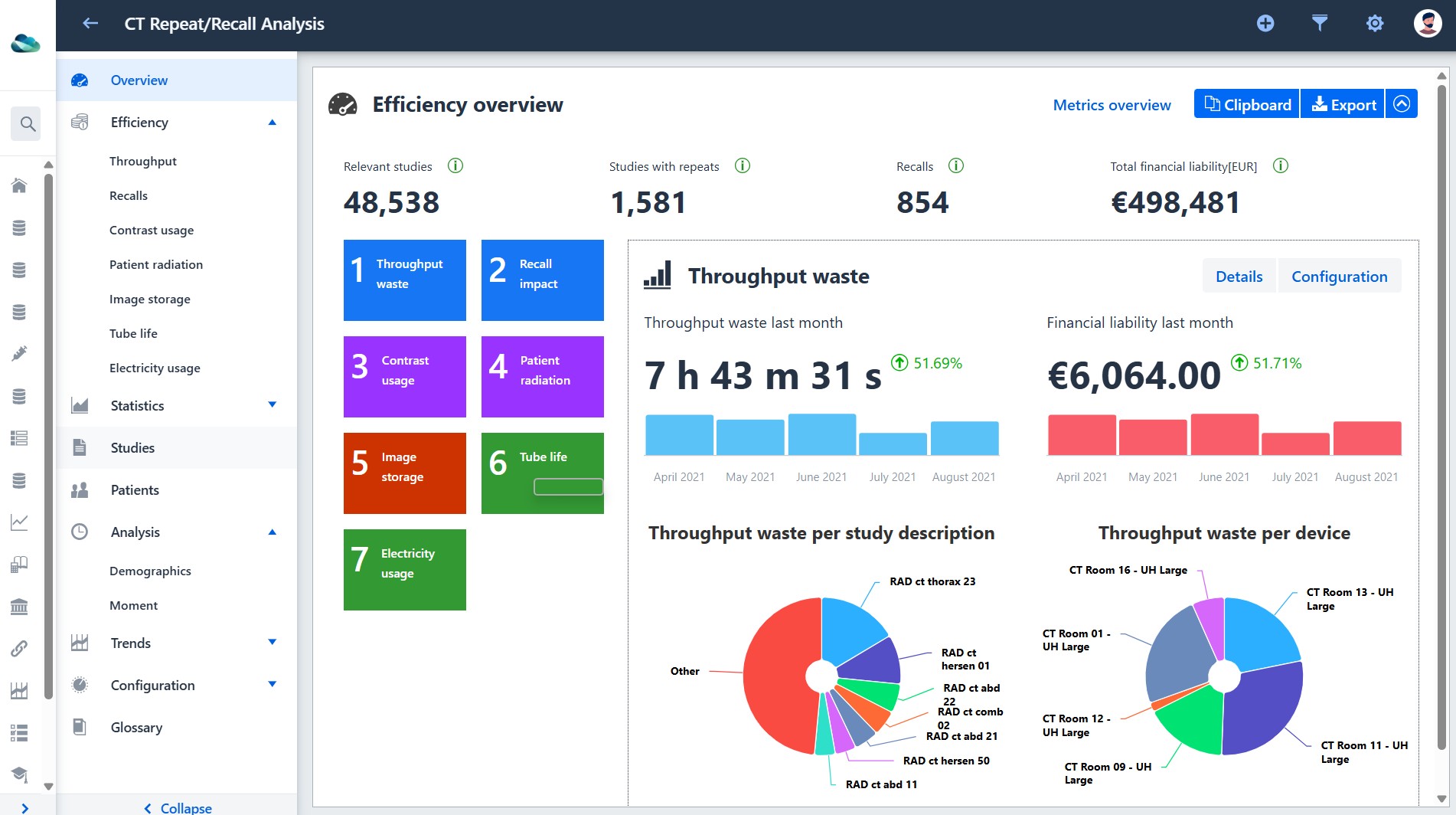
- Important metrics on the analyzed studies and the identified repeated scans offer **an overview at a glance**.
- The intuitive interface allows for an **easy and quick navigation** in the different types of calculated **repeat rates**.
- **Flexible filtering and automated insights** allow for thorough monitoring of the calculated repeat rates at hospital, scanner, operator and protocol level.
- Differentiating on repeat rates per acquisition type indicates **which finding is** more **crucial** to consider **and** what **kind of intervention** it requires.
- **Clinically relevant repeats are excluded** with a click to avoid having false positives results. This way, potential high repeat rates which should not be considered problematic are avoided and the real repeat rate is calculated.
### Assess efficiency losses
- Direct **calculation of the efficiency** based on relevant indices.
- How long does a study last? What is the impact on time duration when unnecessary scans are involved? These questions are turned into numbers and the estimated **impact on financial liability is quantified**.
- Modifying **simulation** parameters, like the number of staff involved or the hourly cost of the device, allows to **reevaluate and compare**.
- Evaluating how other **key performance indicators** are also affected, helps to easier work towards optimization.
- These metrics depicting the actual situation of the department offer an invaluable assistant to the management to **acknowledge potential problems through tangible insights**.
### Simplify improvement execution
- Going beyond simple monitoring, this module allows to **act upon findings.**
- A high repeat rate protocol which requires optimization, an operator who needs extra training or a device with reduced performance are examples of findings subject to **improvement tasks.**
- Directly creating an improvement when high repeat rates and reduced efficiency are identified, helps to **act fast** and have **everything centralized** in one platform while monitoring the execution.
- Simplify the creation of improvement plans by defining **report templates**
- Following what has been found in the literature and setting internal targets based on the actual findings of the repeat rates in the department will help the team to **understand** the associated **costs** and be **more engaged.**
- Recording the before and after situation, as well as the actions taken, allows to show documented proof of the **constant quality improvements.**
### Maintain proper usage
- Static monitoring of repeat rates is not enough. To have a better view of the situation, **a trend over time** is provided.
- Flexible trend lines allow to **easily navigate** through all the points in time when data was analyzed or through a selected time frame.
- The user can assess **how the repeated scans evolve in time and how targeted interventions influenced the practice**.
- By filtering, the analysis over time can focus on specific scanners, protocols, study descriptions, operators for an easier understanding of the situation.
- Advanced reporting ensures disseminating the findings to relevant stakeholders to acknowledge continuous quality improvement and actions towards excellence.
Features
- [Overview](#Overview)
- [Actionable insights](#Actionableinsights)
- [Efficiency metrics](#Efficiencymetrics)
- [Relevant repeats](#Clinicallyrelevantrepeats)
- [Trends](#Trends)
- [Data collection](#Datacollection)
## Overview
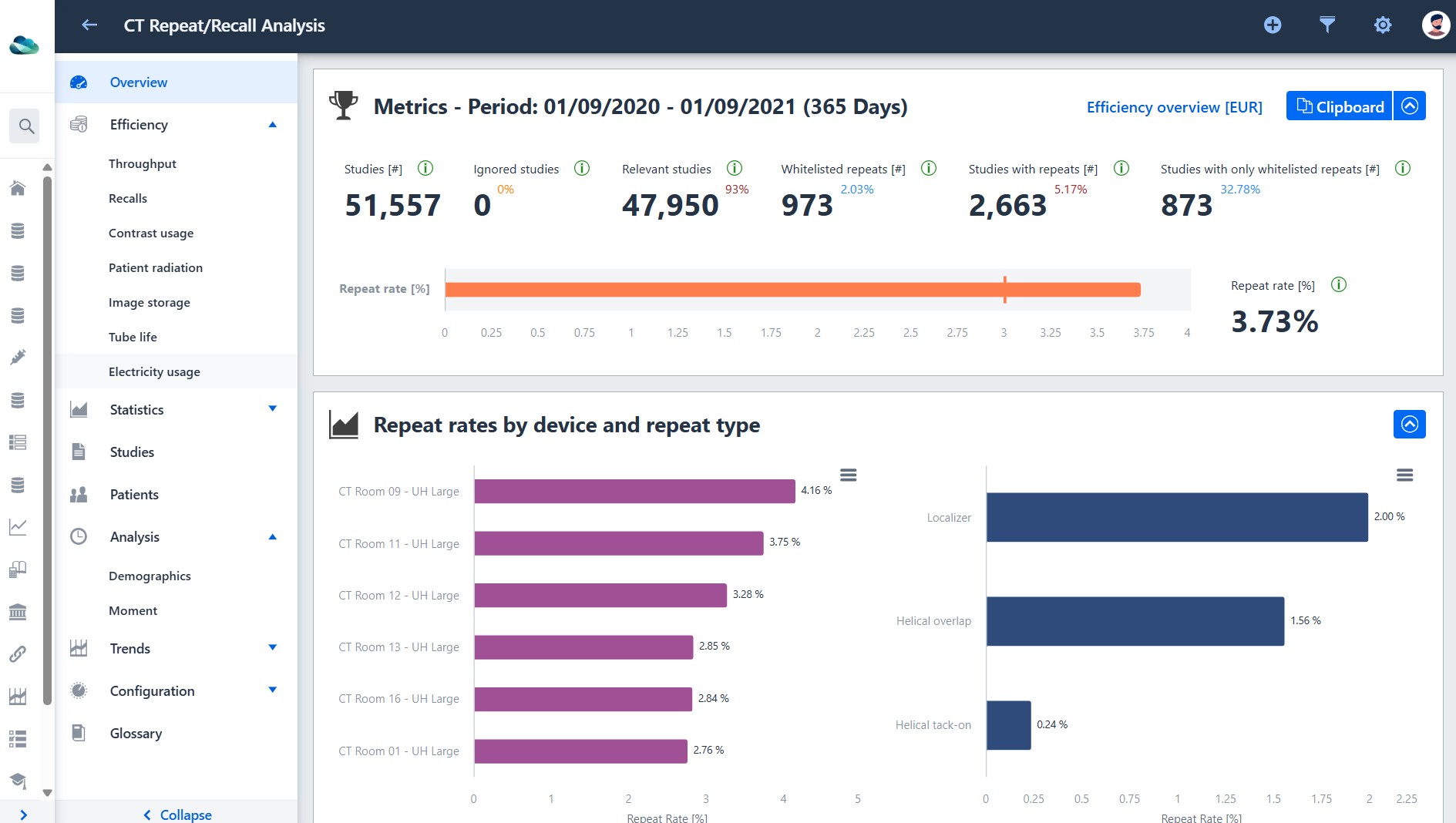
Important metrics on the number of identified repeated scans offer a quick overview of the current situation. Advanced visualisations indicate if the calculated repeat rate value complies with the targets set by the department. Following what has been found in the literature or taking a step by step approach to optimize your department based on the initial findings will allow to assess what the situation is now and act to improve while monitoring the way.
[](https://qaelum.com/images/galleries/CT_repeat/Foqal%20CT%20Overview.jpg)
## Actionable insights
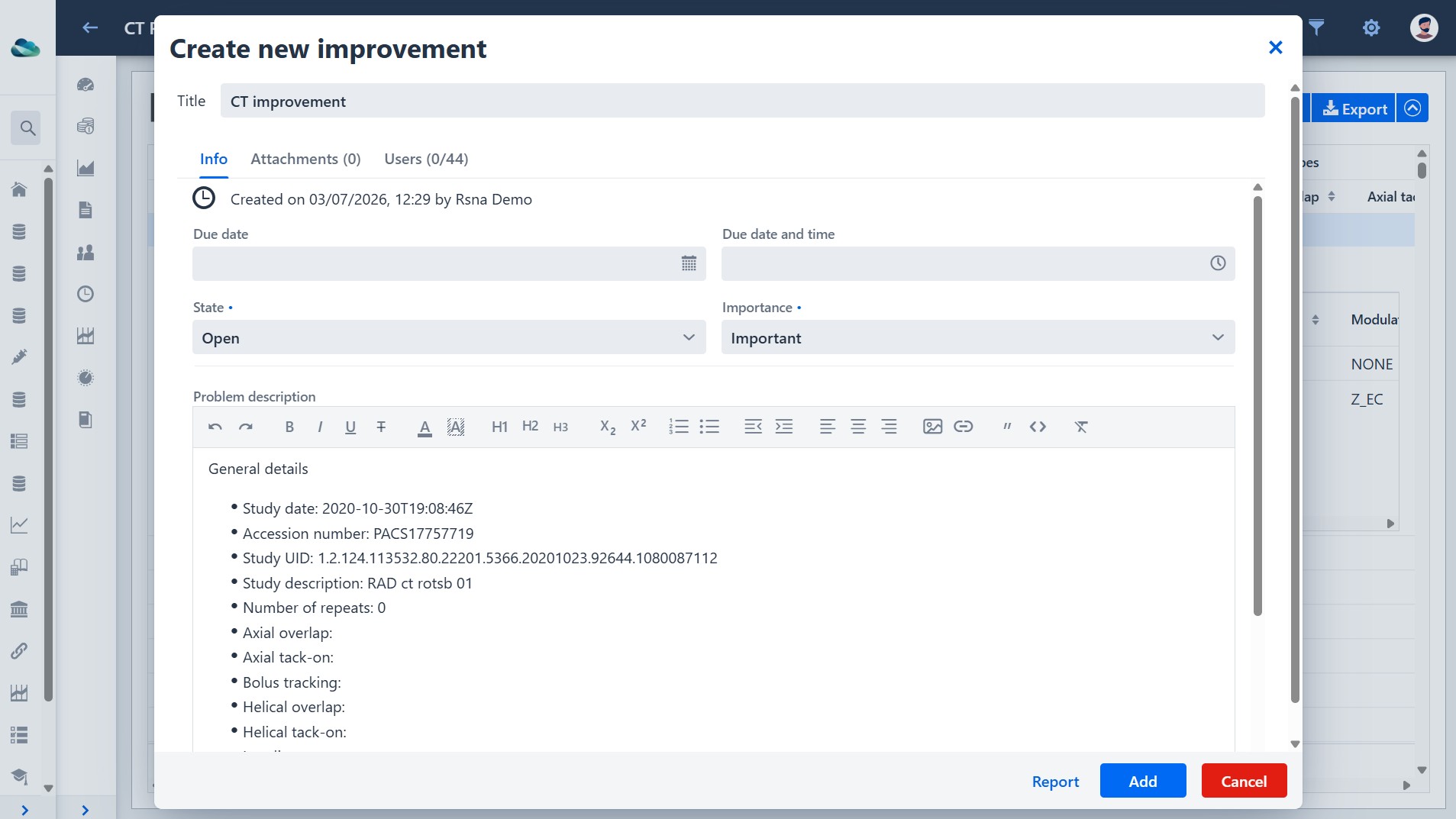
The intuitive interface allows for an easy and quick navigation in the offered options. The user can evaluate the calculated repeat rates, apply filters, check the automated insights, assess the liabilities and set improvements. A high repeat rate protocol which requires optimization, an operator who needs extra training or a device with reduced performance are examples of findings subject to improvement tasks. The user can record the before and after situation, as well as the actions taken, to show documented proof of the constant quality improvements.
[](https://qaelum.com/images/galleries/CT_repeat/Foqal%20CT%20actionable%20insights.jpg)
## Efficiency metrics
Going beyond simple monitoring, this module provides direct calculations of the efficiency based on relevant indices. How long does a study with repeats last versus similar ones without repeats? What is the impact on time duration when unnecessary scans are involved? These questions are turned into numbers and the impact on financial liability is quantified. Modifying simulation parameters, like the number of staff involved or the hourly cost of the device, allows to reevaluate and adapt the simulations to the local situation. These metrics depicting the actual situation of the department, offer an invaluable assistant to management to acknowledge potential problems through tangible insights. If our Foqal CT Repeat module would be combined with our [Contrast Management module](https://qaelum.com/solutions/contrast-management), the potential waste in contrast volume can be taken into account as well. [](https://qaelum.com/solutions/contrast-management)[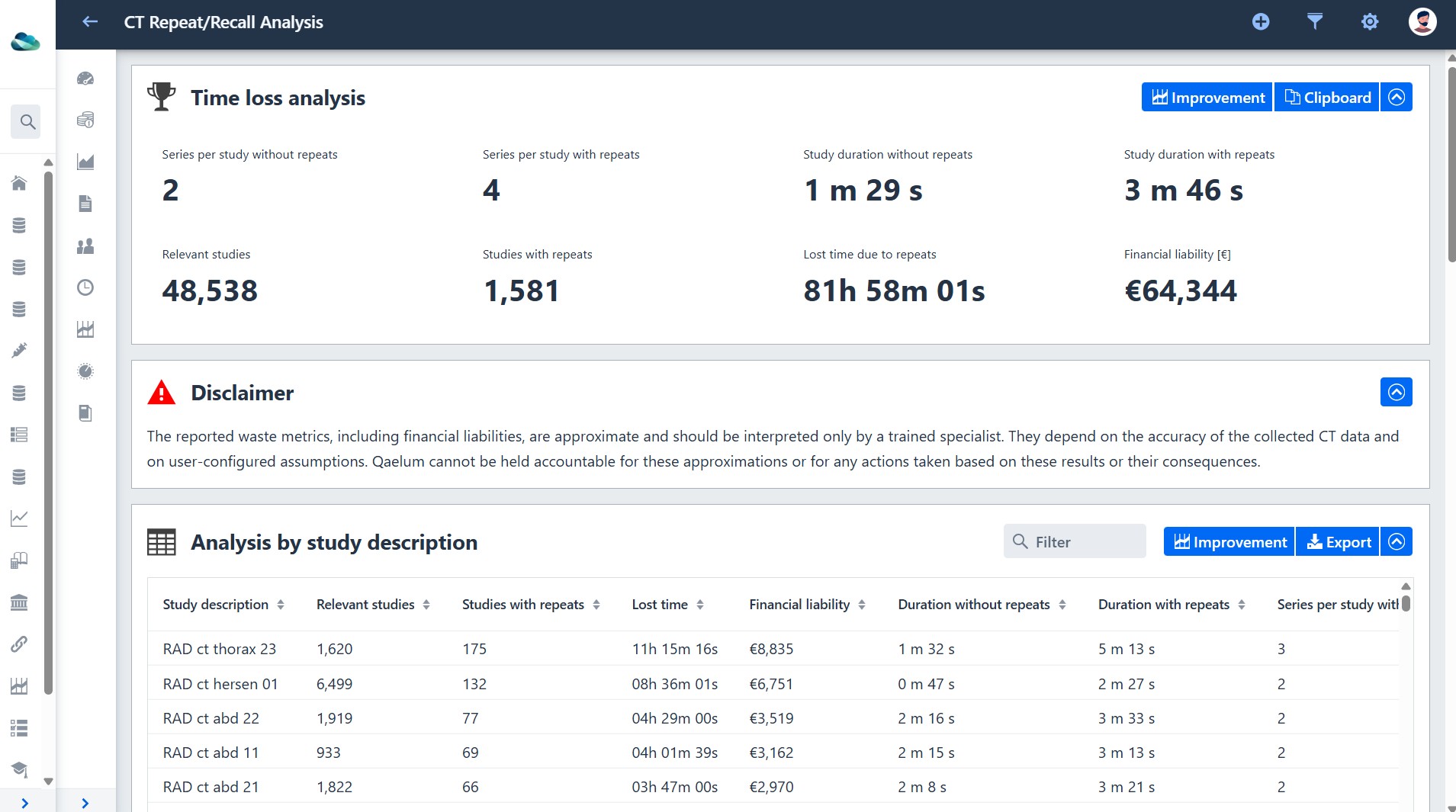](https://qaelum.com/images/galleries/CT_repeat/Foqal%20CT%20efficiency%20metrics.jpg)
## Relevant repeats
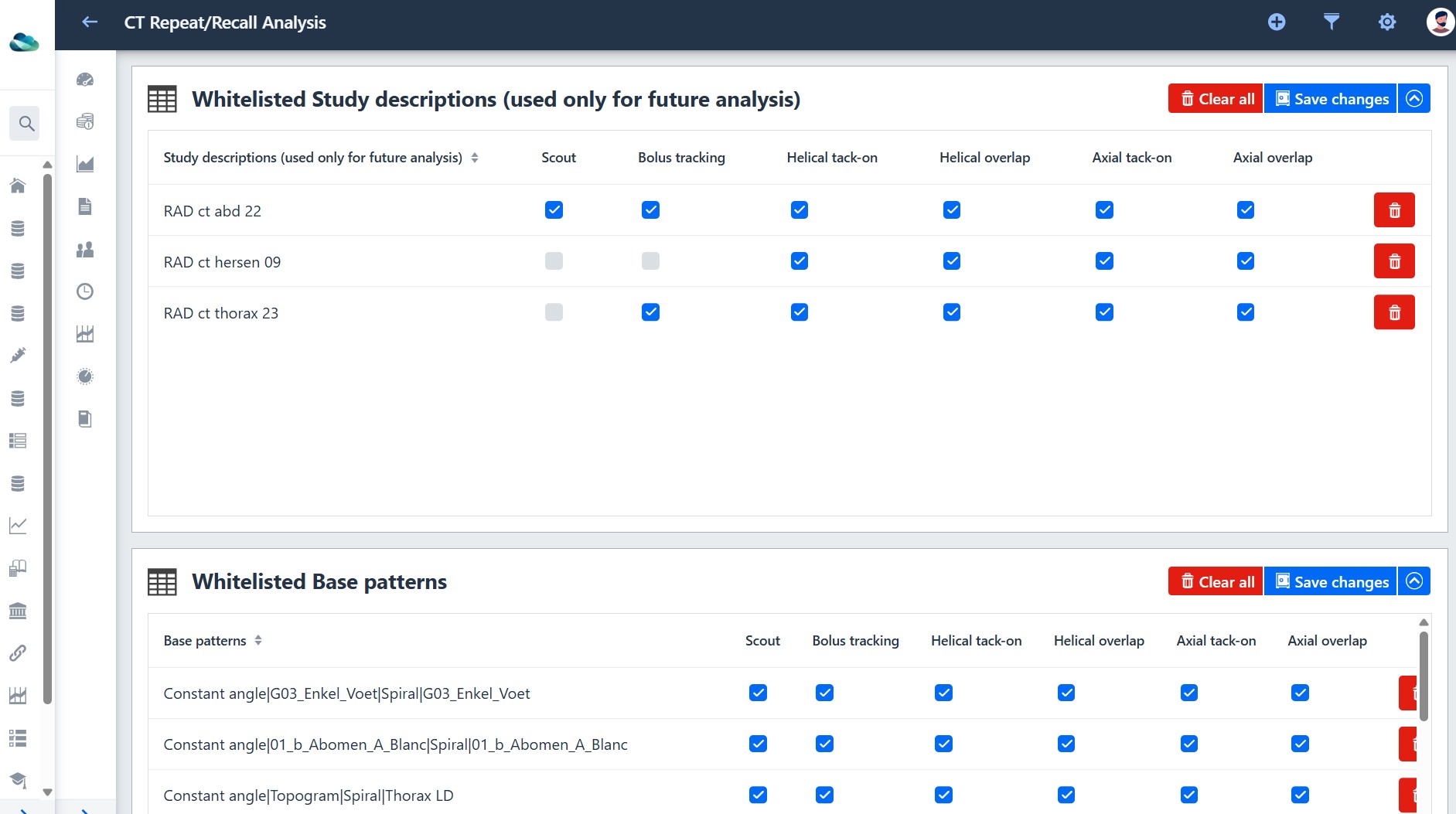
The repeated scans are not always unjustified. Departments may work in a way where repeats in specific protocols are relevant or sometimes additional scans are performed upon request of the radiologist. In the Foqal CT Repeat module these cases can be easily excluded by considering them ‘whitelisted’ with a click. This way, potential high repeat rates which should not be considered problematic are avoided and the real repeat rate is calculated.
[](https://qaelum.com/images/galleries/CT_repeat/Foqal%20CT%20relevant%20repeats.jpg)
## Trends
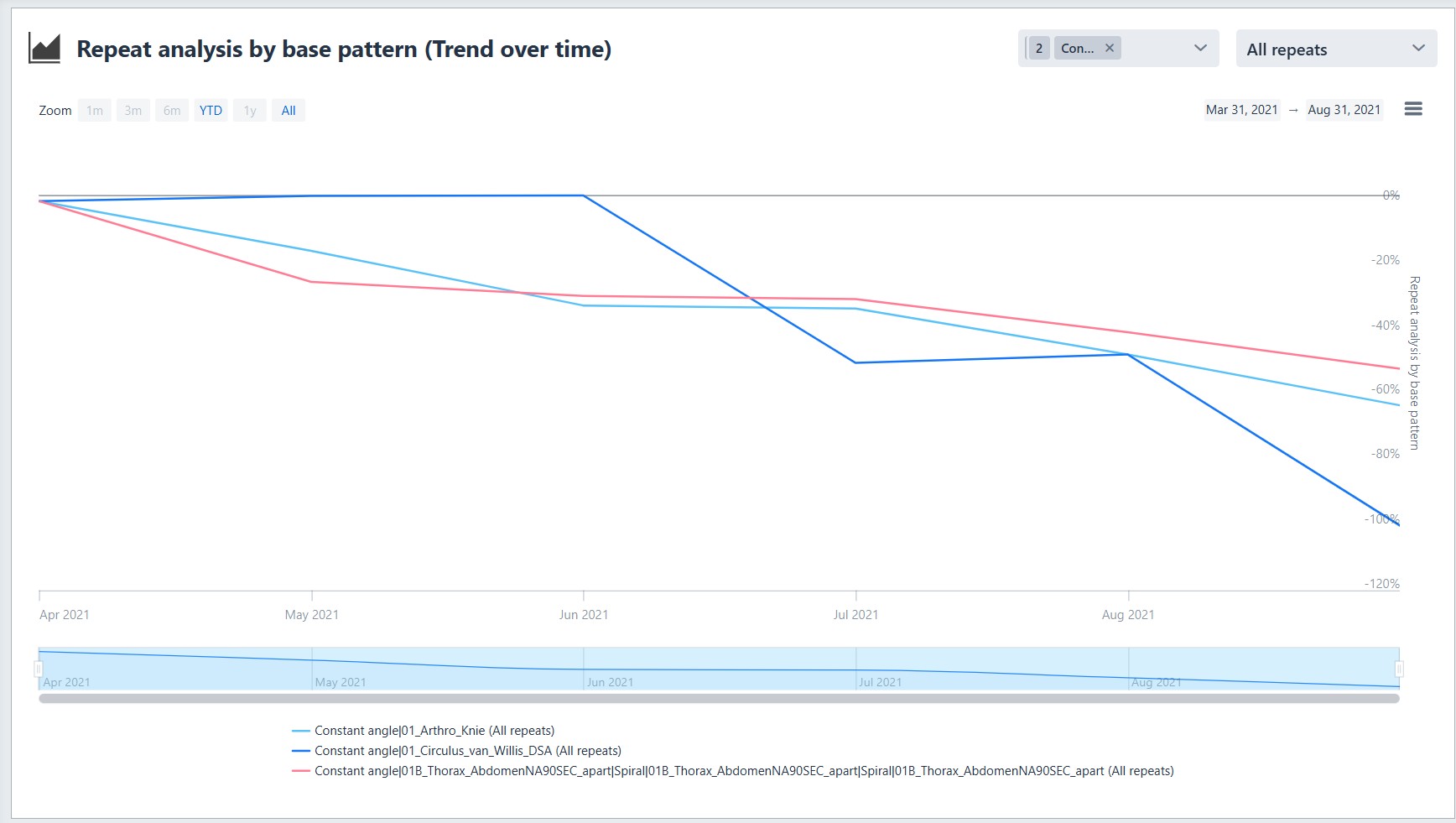
Static monitoring of repeat rates is not enough. To have a better view of the situation, a trend over time is needed. The Foqal CT Repeat module provides trend lines through all the points in time were data are analyzed or through a selected time frame. This way the user can assess how the rates evolve in time and how targeted interventions influenced the practice. It is possible to simply narrow down the used dataset to focus on trends over specific scanners, protocols, study descriptions, or operators for an easier understanding of the situation.
[](https://qaelum.com/images/galleries/CT_repeat/Foqal%20CT%20Trends.jpg)
## Data collection
The Foqal CT Repeat module is a vendor-neutral solution that integrates into your existing IT infrastructure using industry standards. It collects its data from PACS systems, directly from the CT device itself, or from already available radiation dose management systems.
[](https://qaelum.com/images/solutions/CT_repeat/data-collection.png)
Video
## Video
Publications
Rose S, Viggiano B, Bour R, Bartels C, Kanne J, Szczykutowicz T. “*Applying a New CT Quality Metric in Radiology: How CT Pulmonary Angiography Repeat Rates Compare Across Institutions.*” Journal of the American College of Radiology, 2021, 18(7). DOI: 10.1016/j.jacr.2021.02.014. [Link](https://www.sciencedirect.com/science/article/abs/pii/S1546144021001472)
Rose S, Viggiano B, Bour R, Bartels C, Szczykutowicz T. “*A Multiinstitutional Study on Wasted CT Scans for Over 60,000 Patients*.” American Journal of Roentgenology, 2020, 215:5, 1123-1129. DOI: 10.1016/j.jacr.2021.02.014. [Link](https://www.ajronline.org/doi/full/10.2214/AJR.19.22604)
Szczykutowicz T, Rose S. “*Repeat/Reject imaging in CT: An unnecessary source of patient dose and a tax to radiology resources*.” European Congress of Radiology, ECR 2020, Vienna, Austria. DOI: 10.26044/esi2020/ESI-02989. [Link](https://epos.myesr.org/poster/esr/eurosafeimaging2020/ESI-02989)
Szczykutowicz T, Rose S. “*First Look: Repeat Rates in CT*.” Radiology Management, 2019, 41(5). [Link](https://www.radiologymanagement-digital.com/radiologymanagement/09102019/MobilePagedArticle.action?articleId=1539504#articleId1539504)
Fitousi N, Binst J, Szczykutowicz T, Rose S, Coudyzer W, Bosmans H, Van Ongeval C, Jacobs J. "*Automated analysis of CT repeated scans in a large European hospital"*. European Congress of Radiology , ECR 2022, 2 – 6 March 2022 (online) & 13 – 17 July 2022, Vienna, Austria.
Webinar
## Recorded Webinar
# A source of radiation dose doubling and wasted scan time
In this webinar, a topic of growing concern in CT, the unnecessary repeated scans, is discussed. We discuss how repeated examinations lead to doubling of patient dose and longer and more unpredictable exam durations. We also discuss the cost and potential harm caused by administration of extra contrast agents associated with repeated imaging. We also review a new quality improvement tool for quantifying repeated imaging.
#### Presented by
| #### Timothy P Szczykutowicz Dr. Tim “Stick” Szczykutowicz is a Professor at the University of Wisconsin Madison, Department of Radiology. Dr. Szczykutowicz is author of over 40 papers, 3 patents, and the book “The CT Handbook: Optimizing Protocols for Today’s Feature-Rich Scanners”. |  |
|---|---|
## Fill out the form to watch the webinar recording
Email Address
Marketing PermissionsPlease select all the ways you would like to hear from :
Email Direct Mail Customized Online Advertising You can unsubscribe at any time by clicking the link in the footer of our emails. For information about our privacy practices, please visit our website.
We use Mailchimp as our marketing platform. By clicking below to subscribe, you acknowledge that your information will be transferred to Mailchimp for processing. [Learn more about Mailchimp's privacy practices here.](https://mailchimp.com/legal/)
## Foqal CT Repeat by Qaelum – Frequently Asked Questions
### What is Foqal CT Repeat by Qaelum?
Foqal CT Repeat is a vendor-neutral software solution developed by Qaelum to analyze and reduce unnecessary repeated CT scans. Based on patented technology from the University of Wisconsin, it identifies repeat scans that may indicate protocol inefficiencies, clinical workflow issues, or training needs. The tool supports continuous quality improvement by providing actionable insights, efficiency metrics, and direct support for intervention planning.
### Why should healthcare providers use Foqal CT Repeat?
Foqal CT Repeat helps radiology departments identify hidden inefficiencies caused by unnecessary repeated scans, which often go unnoticed but add to patient radiation dose, increase contrast media usage, and reduce overall productivity. By using Foqal CT Repeat, institutions can reduce liability, improve safety, and optimize operational costs while supporting staff training and protocol refinement.
### How does Foqal CT Repeat collect and analyze data?
Foqal CT Repeat collects data automatically from all major CT scanner manufacturers through industry-standard interfaces, PACS systems, or dose management platforms. Its built-in scheduler enables periodic analysis, offering insights at hospital, device, protocol, and operator levels. It identifies both justified and unjustified repeats, allowing users to ‘whitelist’ clinically relevant cases to ensure accurate reporting.
### What insights and metrics does Foqal CT Repeat provide?
Foqal CT Repeat provides repeat rates by protocol, operator, or scanner, highlighting inefficiencies and potential improvement areas. It quantifies the impact of repeats on study duration, resource utilization, and financial costs. Users can simulate efficiency gains by adjusting variables like staff involvement or device cost. It also integrates with Qaelum’s Contrast Management module to factor in contrast media waste.
### Can Foqal CT Repeat support improvement tracking and long-term monitoring?
Yes, Foqal CT Repeat goes beyond monitoring by enabling users to define improvement plans, assign tasks, and track the before/after performance. It supports time-based trend analysis to evaluate how repeat rates evolve and how interventions impact performance. Comprehensive reports and visual dashboards help share insights across departments and support ongoing quality assurance.